

The Everything War
A conflict where so many fault-lines have intersected.

How will historians describe the Iran War, and the events of the past six weeks? It hasn’t been a World War. Not enough major powers have been directly involved. It has, though, been a globalised war, since its effects have been felt by people everywhere, save for the dark side of the moon.
In March, The Economist spoke of two parallel wars: “One is the campaign of American and Israeli air strikes against the Iranian regime; the other is Iran’s war on the global economy.” But it has been broader and more all-encompassing.
Another way of thinking of this conflict is as an Everything, Everywhere All at Once War, a polyconflict where so many fault-lines have intersected and so many ripple effects have been felt the world over: geopolitical, economic, religious, civilisational, cultural, racial and party political. Now that a brittle ceasefire is in place, at least between Washington and Tehran, I have attempted to list them, although this inventory is by no means exhaustive…..
Core conflicts
The battle to open the Strait of Hormuz: Iran is still in control of the Strait of Hormuz, which gives the regime such a strategic edge and makes any US claims of victory sound risible. Obviously Tehran has demonstrated the power of asymmetrical warfare: how inexpensive drones and well-hidden missiles can thwart the world’s most powerful military. It has also demonstrated the chokehold even middle powers can now exert on global supply chains. The Strait is not only a passageway for oil and gas, but fertiliser and helium used in all-important semi-conductors (how often now we speak of the strategic power of semi-conductors). Fuel, farming and the high-tech sector. No wonder this has been an Everything, Everywhere All at Once War. As I wrote in the week: “Before the conflict began, the Strait of Hormuz was regarded as an international waterway. Now it looks more like an impregnable fortification offering a security guarantee for a murderous regime."
Trump v. Trump: in his public pronouncements, the president has pinballed all over the place. His decision-making has lacked strategic foresight. His public statements have been demented. Often Trump sounds more like a content provider from the darker reaches of the manosphere than commander in chief. Trump slop, I call his tirades and slaloming press availabilities. Ever the executive producer of his own presidency, he thrives on cliffhangers and “tune in at eight” sort of ultimatums. Often, they shift, hence the taunt TACO Trump.
Mad man theory or simply mad man? Now there is a symbiosis between the two. On Easter Sunday, the holiest day in the Christian calendar, he fumed on social media, “Open the Fuckin’ Strait, you crazy bastards, or you’ll be living in Hell.” Less than two days later he warned, like some impresario of Armageddon, Tuesday night may well be “one of the most important moments in the long and complex history of the World”, adding: “A whole civilization will die tonight, never to be brought back again.” They are defining posts, which will be quoted for centuries to come, that capture both the darkness and mental instability of his presidency. Iran scholar Karim Sadjadpour of the Atlantic Council put it well this week: “The defining deliberations of this war aren’t between the US and Iran, but Trump and himself.”
The regional conflict: Fears of a regional conflict were instantly realised with Lebanon, Iraq, Israel, UAE, Saudi Arabia, Kuwait, Bahrain, Oman, Syria, Jordan, Azerbaijan and even Cyprus coming under fire. With more than a dozen countries directly involved, this has been the broadest Middle East conflict since the Yom Kippur War in 1973. Crucially, though, Saudi Arabia and its neighbours have not joined the battle against Iran primarily because of the fear of Iranian retaliation wreaking more havoc on their energy infrastructure, and inflicting long-term damage.
Israel v. Hezbollah: on March 2, Israel launched air strikes across Lebanon, after Iran’s proxy Hezbollah fired rockets into Israel in response to the assassination of the late Supreme leader, Ayatollah Ali Khamenei. On March 16, Israel launched a ground invasion of south Lebanon, which is still ongoing. Up until the last 72 hours, during which Israel has continued its bombardment despite the broader ceasefire, it has been the neglected front of this conflict. A war within a war. The Israeli prime minister, Benjamin Netanyahu, has been claiming the ceasefire does include its operation in southern Lebanon. Trump has told NBC News, that Israel will be “scaling back” its attacks, another sign of his desperation to make this ceasefire hold and to bring this war to a speedy, though inconclusive end, with few of America’s original war aims achieved.
Iran regime and the Iranian people: never should we forget the murderous brutality the theocratic regime has shown towards its own people, especially during the popular uprising at the start of 2026. The US and Israeli military campaign “has frozen these movements, eliminating any space for protest,” explained Iranian political activist Behrouz Farahani in an interview with Qantara.de.
Broader geopolitical conflicts
The Trump administration v. NATO: last week NATO marked - celebrated is not the right word - its 77th anniversary. But the war has exposed the widening oceanic divide threatening the survival of an alliance widely seen as the most successful and enduring defence pact in modern history. Trump is openly scornful of what he sees as the cowardice of countries such as the UK and France, which have refused to send warships to the Strait of Hormuz. The French president, Emanuel Macron has been openly scornful back. “This is not a show,” he said on a trip to South Korea. “When you want to be serious you don’t say every day the opposite of what you said the day before. And maybe you shouldn’t be speaking every day.” When a war goes awry, find a scapegoat. That explains a lot of NATO-bashing at the moment from Trump and his acolytes, which continued this week when Mark Rutte, the sycophantic Secretary-General of NATO, visited Washington. “NATO wasn’t there when we needed them, and they won’t be there if we need them again,” moaned Trump on social media. The Iran war has exacerbated a crisis the Trump administration brought on with its territorial designs on Canada and Greenland.
Ukraine v. Russia: Vladimir Putin’s war machine has benefitted enormously from the loosening of US oil sanctions. This financial boost, moreover, came at a vital moment. In February, for the first time since November 2023, Russia lost more ground in Ukraine than it gained, according to the Warsaw Institute. Ukrainian forces, according to Volodymyr Zelensky, have liberated approximately 300 square kilometers along the southern front following recent counter-offensives. Kyiv’s mastery of counter-drone technology has also made it a player in the Iran conflict, the go-to nation for expertise. Last month, Zelensky made a high-profile visit to Saudi Arabia, with a swagger in his step and a trump card in his hand, where he signed a defence agreement with Saudi Crown Prince Mohammed bin Salman.
U.S. v. China: China has opted for the Bonaparte doctrine during this conflict: “Never interrupt your enemy when he is making a mistake,” a famed quote attributed to Napoleon which has become a go-to during this conflict for so many commentators. It’s a re-run of the strategy during the Iraq war, when Beijing continued its quiet and rapid 21st century rise while the United States squandered so much blood and treasure. Like Iraq, the Iran war is being viewed in Beijing as an accelerant of US decline. China is heavily dependent on oil passing through the Strait of Hormuz, but has cut deals with the Tehran regime to secure safe passage. Often we fixate on the transactional nature of Trumpian diplomacy. President Xi Jinping plays that game, too, with greater strategic prudence. Just witness its use of “chequebook diplomacy,” the strategic use of foreign aid.
Culture wars
Holy War and civilisational conflict: as we noted at the start of the conflict, Secretary of War Pete Hegseth, who has a Crusader emblem inked into his skin, has the fervour and zeal of a Holy warrior. The former Fox News host has beseeched Americans to pray “every day, on bended knee” for a victory “in the name of Jesus Christ.” In Trump’s expletive-laden social media post on Easter Sunday, he ended by mocking Islam, with the pay-off “Praise be to Allah.” Even if it was meant as a negotiating ploy, Trump’s threat “a whole civilisation will die tonight” threat was alarmingly apocalyptic. End of times rhetoric which some US evangelicals yearning for Christ’s second coming, rejoice in.
American President v. American Pope: billed as a battle between the two most powerful Americans in the world, Pope Leo XIV has pushed back against the idea that the Iran war has a divine justification, and that his homeland automatically enjoys the backing of the Almighty. “Jesus is the King of Peace, who rejects war, whom no one can use to justify war,” he said on Palm Sunday. “He does not listen to the prayers of those who wage war but rejects them.” In a previous homily, which also seem directed at the Pentagon, Pope Leo claimed Jesus “does not listen to the prayers of those who wage war, but rejects them.” After Trump issued his “whole civilisation will die tonight” threat, Pope Leo said threats against Iran’s population were “unacceptable.” This week, it was even reported that, in angry meeting, the Pentagon lectured the Pope’s ambassador on the Trump administration’s ability to do whatever it wants in the world. A newsletter called Letters from Leo reported: “As tempers rose, an unidentified U.S. official reached for a fourteenth-century weapon and invoked the Avignon Papacy, the period when the French Crown used military force to bend the bishop of Rome to its will.”
American secularism v. American religiosity: as we approach the 250th anniversary of the Declaration of Independence, it’s worth restating that the founding fathers were secularist in their outlook and unexpectedly ungodly. Proof? They set up the first republic in the world that legally separated church from state. Pete Hegseth won’t like this much, but James Madison, who is widely acclaimed as “the Father of the Constitution,” was opposed to military chaplains.
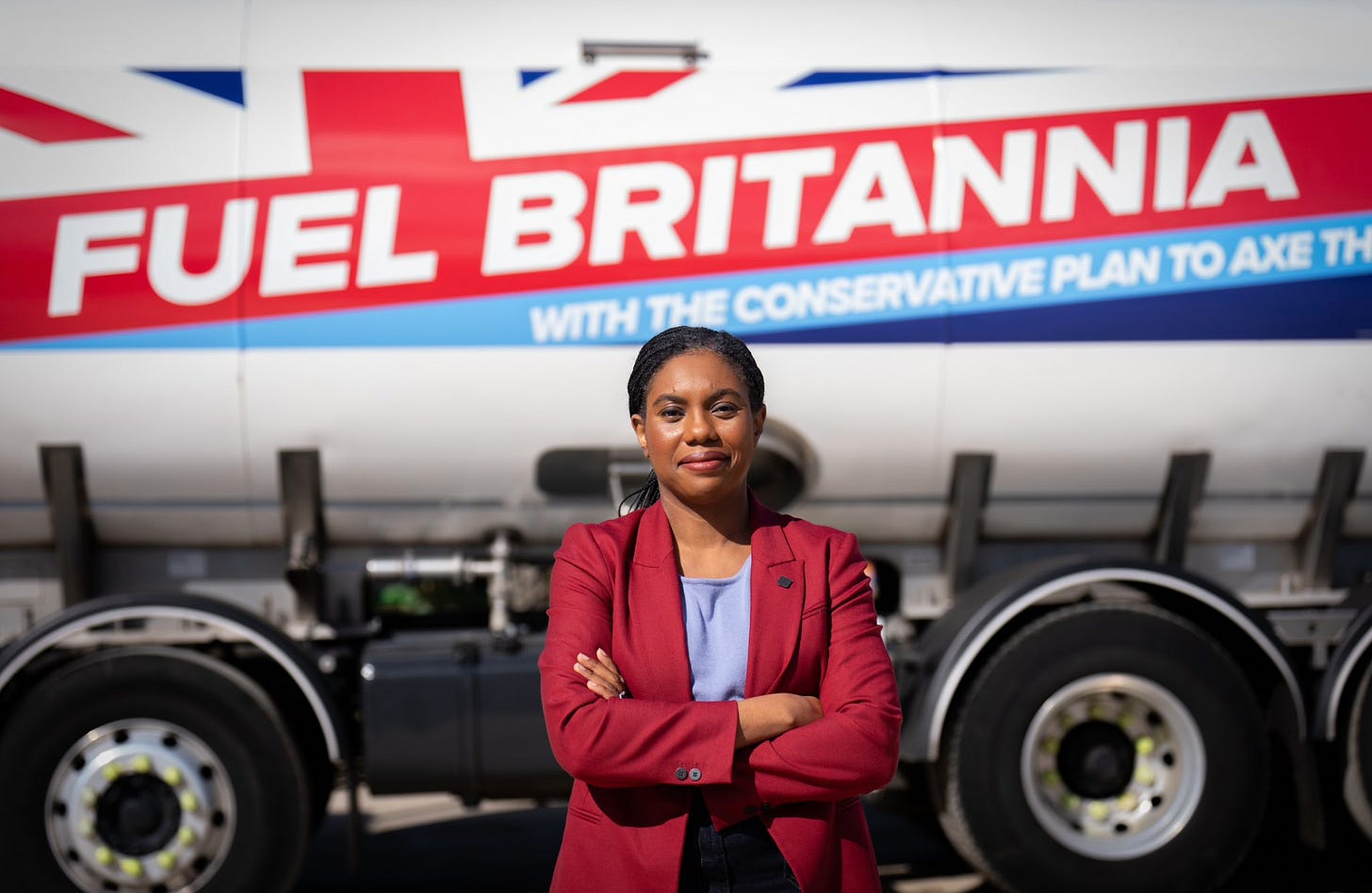
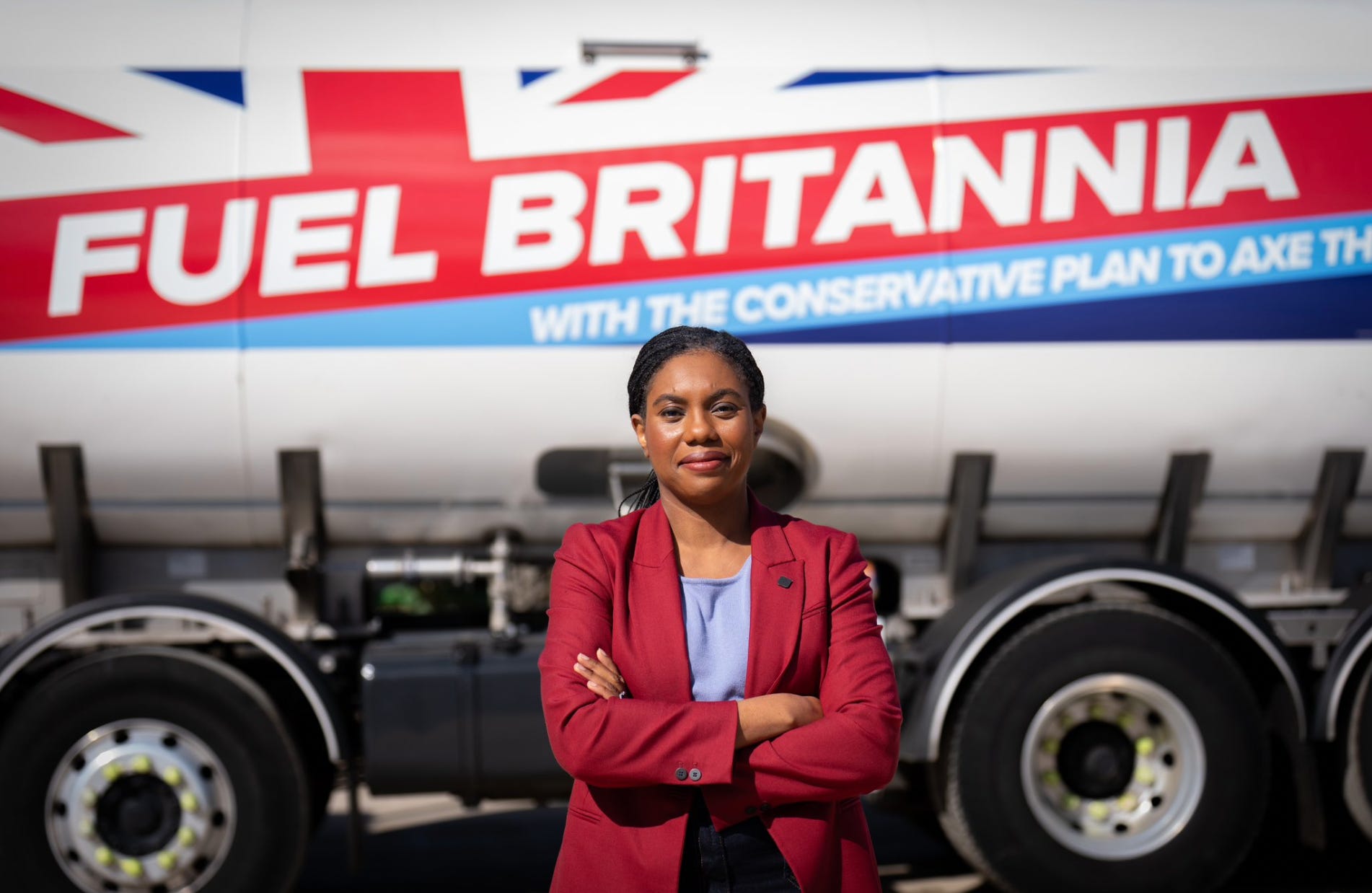
Fossil Fuels v. renewables: it seems ludicrous to frame what should be a matter of science as a culture war battlefront, but that is what resistance to renewables has become. Increasingly in these populist times, the campaign to save the environment has been portrayed as an elite concern and woke endeavour. “Drill baby drill”, a cultural catch-phrase of Donald Trump, has been taken up by others on the right, such as the Conservative leader Kemi Badenoch, who is calling for more drilling in the North Sea. As part of her “Fuel Britannia” campaign, she has published a “Get Britain Drilling” bill. With the world facing its biggest energy shock in history, one would have thought the green movement would be having another Stern Report or Inconvenient Truth moment, which were prompts twenty years ago for urgent global action. Instead, on the right, there’s been a doubling down on fossil fuels.
The Trump administration v. DEI: while the war has been raging, Pete Hegseth has been continuing his fight against diversity, equity and inclusion within the Pentagon. It is thought the enforced retirement of Army Chief of Staff, General Randy A George, stemmed from an ongoing row over Hegseth’s attempts to block or delay the promotions of more than a dozen Black and female senior officers. George, a highly respected and decorated general, had contested they were thoroughly deserving of their promotions. Banished from the Pentagon is one of the grown-ups in the US military.
Political battles
MAGA v. MAGA: some of the most prominent MAGA figures have attacked the Iran war, foremost among them Marjorie Taylor Greene and Tucker Carlson. But hardcore MAGA supporters still seem to back Trump. Reports of a full-blown MAGA revolt tend to be exaggerated. A NBC poll suggested 90 per cent of “self-identified Maga-aligned Republicans” back Operation Epic Fury. Republicans on Capitol Hill have remained largely loyal.
America v. America: during the war, we have seen some of the largest anti-Trump scale protests of Trump 2.0, the self-styled No Kings demonstrations. In late March, millions took part in more than 3,200 rallies in all 50 states.
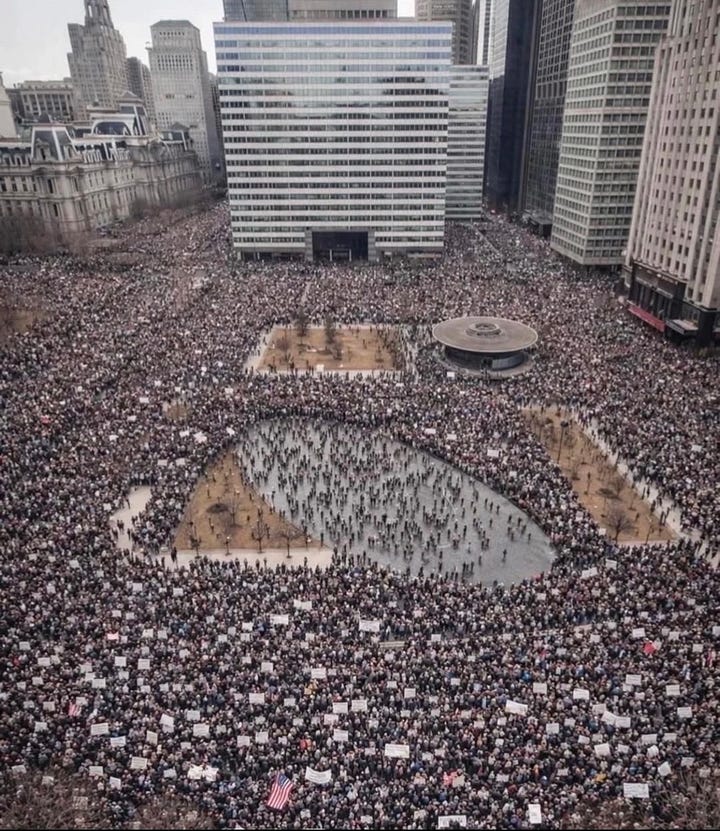
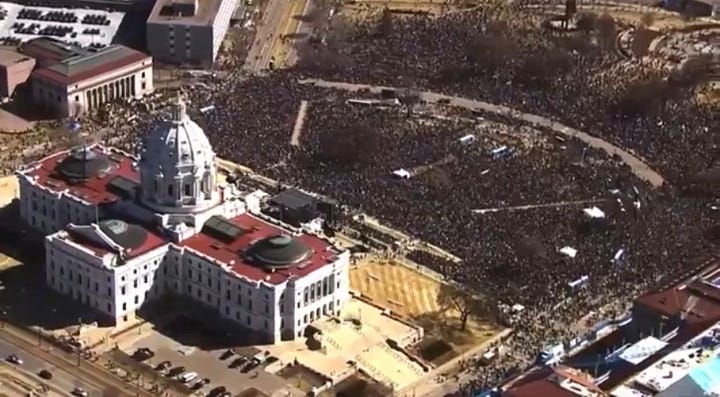
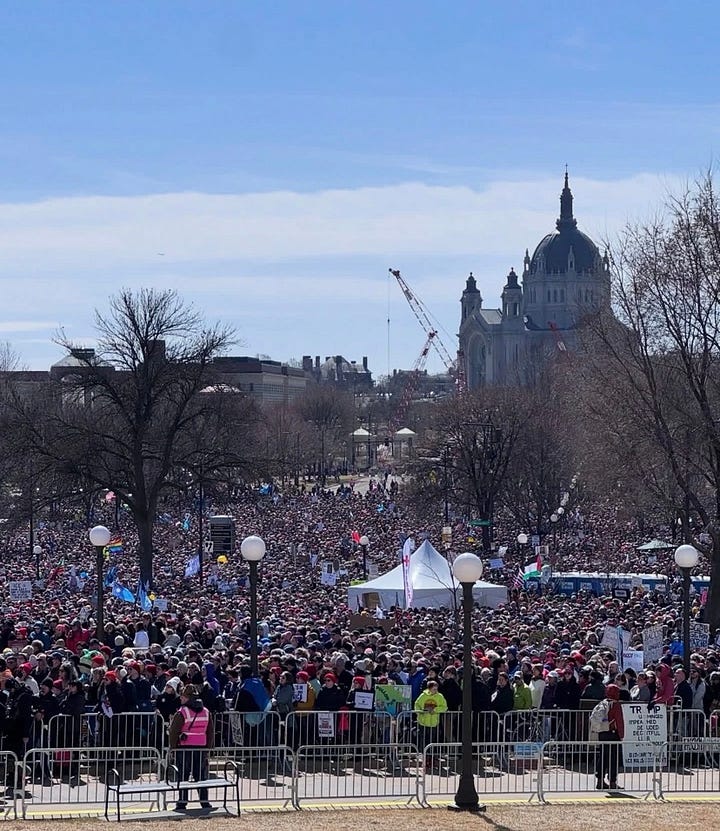
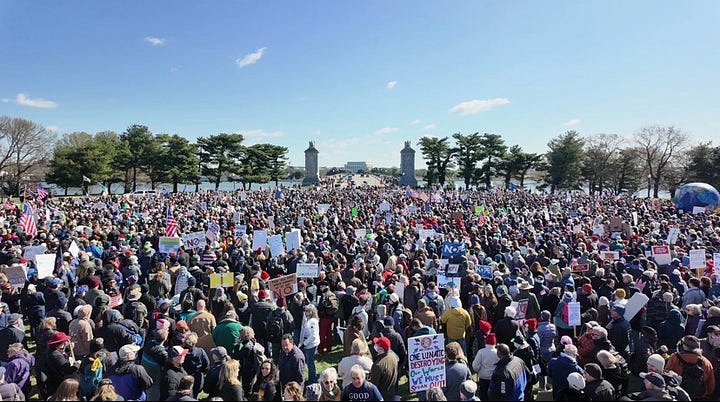
Protests in Philadelphia, Minneapolis and Washington DC Congressional Mid-terms: before Operation Epic Fury, the conventional wisdom was that the Democrats stood a strong chance of winning the House of Representatives but that the Senate would remain in Republican hands, because this year’s political map is so Trump-friendly. So many Senate seats are being contested in red states. But with the president suffering his lowest approval ratings in either term, the Senate could now be in play. Crucially, Trump’s approval rating on the economy has fallen to 31%, according to a new CNN poll which also noted: “The 65% who say Trump’s policies have made the economy worse is the highest of his presidency, higher than the share who said the same about Democrat Joe Biden’s policies at any point during his time in office.”
Billionaires against the rest: what Axios has called an “epidemic of suspicious trading around President Trump's most consequential decisions each time, just minutes or hours before he rattles global markets,” has not only raised suspicions of insider trading, but highlighted the wealth gap in the global economy at a time when so many people are suffering higher fuel and food bills. Prospering at times of global crisis has become a feature of the billionaire economy. COVID-19 provided a classic example. “One effect of the pandemic was to increase the wealth of the billionaires in the US by close to $US 640 billion,” A.C. Grayling notes in For the People: Fighting Authoritarianism, Saving Democracy. “Oxfam says that the ten richest people in the world doubled their combined net worth in the pandemic, putting more into their hands than the combined wealth of the 3.1 billion people at the other end of the scale.”
Localised battles: the political fall-out has been felt everywhere. In Australia, Prime Minister Anthony Albanese has come under fire for the lack of national preparedness for an energy crisis. In the UK, Sir Keir Starmer has faced similar criticisms. Inflationary pressures will add to the crisis of incumbency faced by so many governing parties and possibly help populist parties such as Nigel Farage’s Reform UK and Pauline Hanson’s One Nation. But here we run into the populist paradox, which is worth exploring in a longer piece. Populists could be the beneficiaries of the economic chaos unleashed partly because of the lack of foresight of a populist president.
Postscript
Recently, I wrote recently about what to tell a child about Trump, which became one of History Never Ended most highly-read essays. I published it before his “Open the Fuckin’ Strait, you crazy bastards” social media post…..
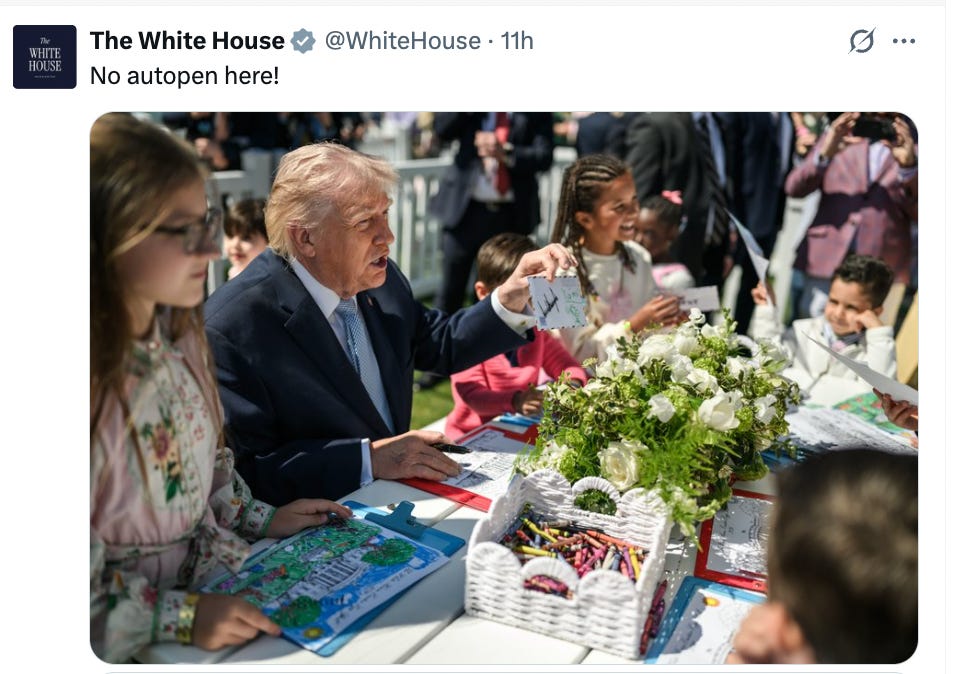
….and also before the White House Easter egg event. Signing artwork drawn by children in the spring sunshine, Trump told the kids “Biden would use the autopen. He was incapable of signing his name, so they’d follow him around with this big machine. You know what it was called? An autopen!” Manna from heaven fo the White House social media team, which politicises everything…….
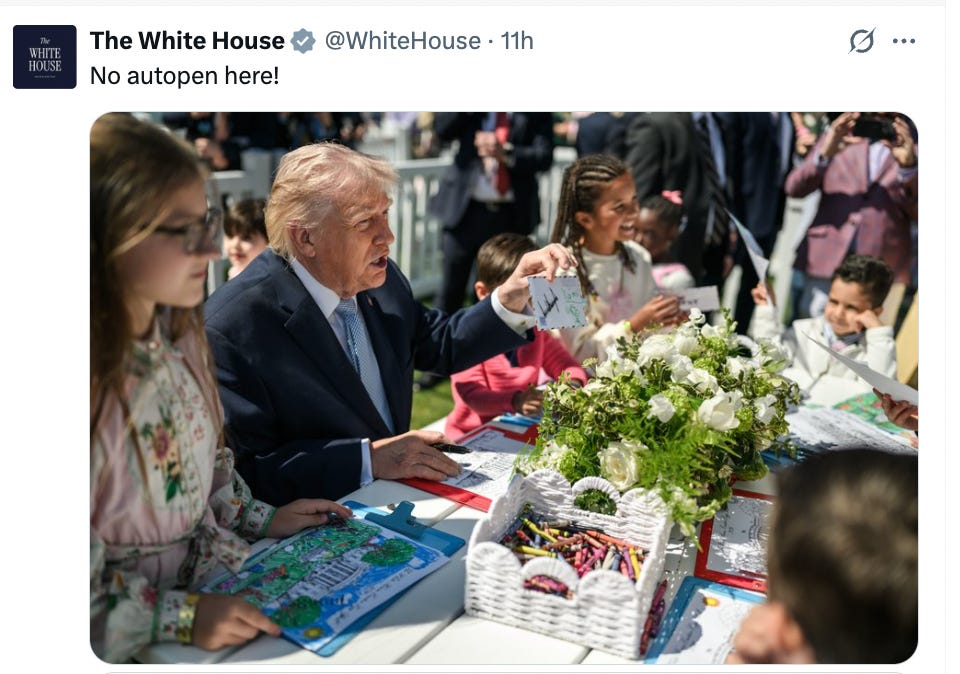
Of the signed artwork, Trump also joked: “you could sell them for $25,000 on eBay.” At the same event, he derided Kamala Harris, his Democratic opponent in 2024, as a “low IQ person.”
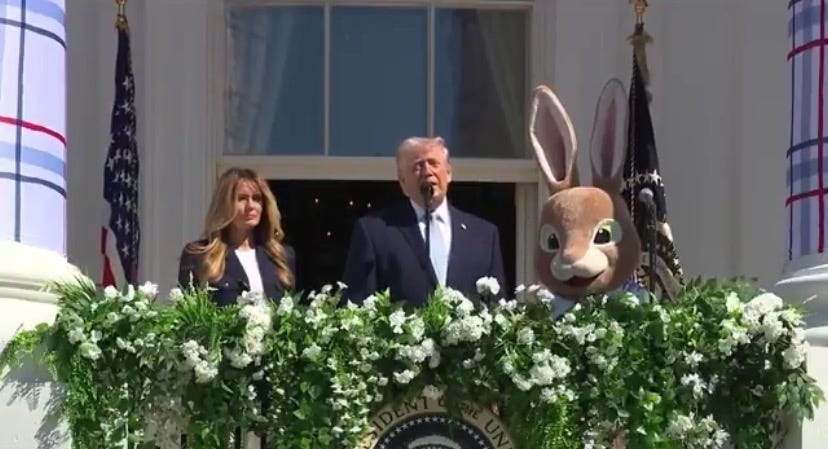
At another point, Trump appeared on a balcony overlooking the South Lawn of the White House where he addressed the Iran war……
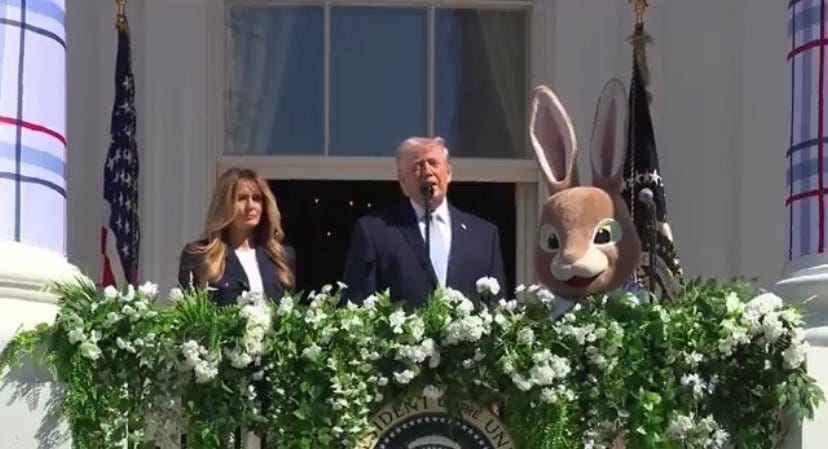
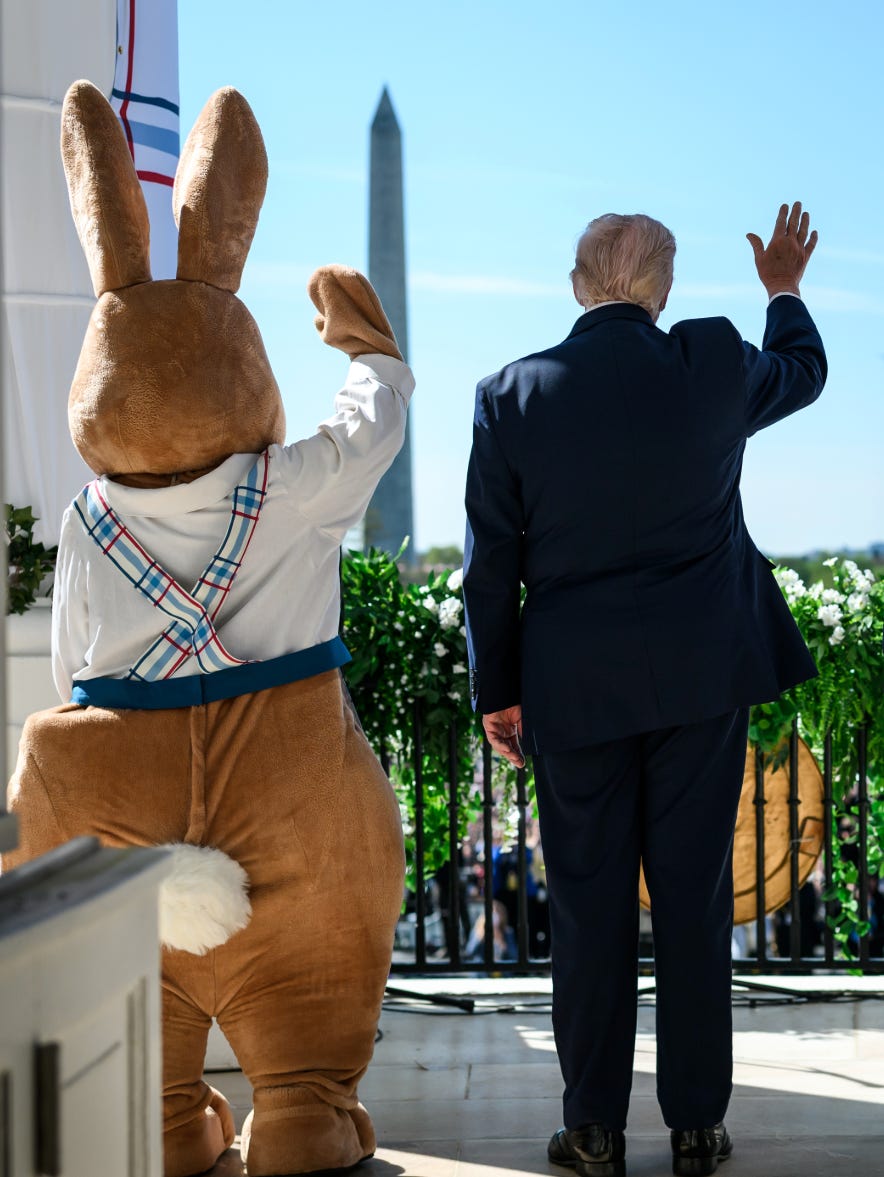
Imagine telling someone in 2015 that a golden escalator would be the portal into a strange new world where, a decade or so later, Donald Trump would end up making proclamations about a new Middle East war with a cross-eyed Easter bunny stood alongside. That it the world we now inhabit. How can satire compete?


Thanks Nick. As always an insightful and thorough article.
Excellent upsum. Thank you